Nerja Cave Paintings, History & Museum
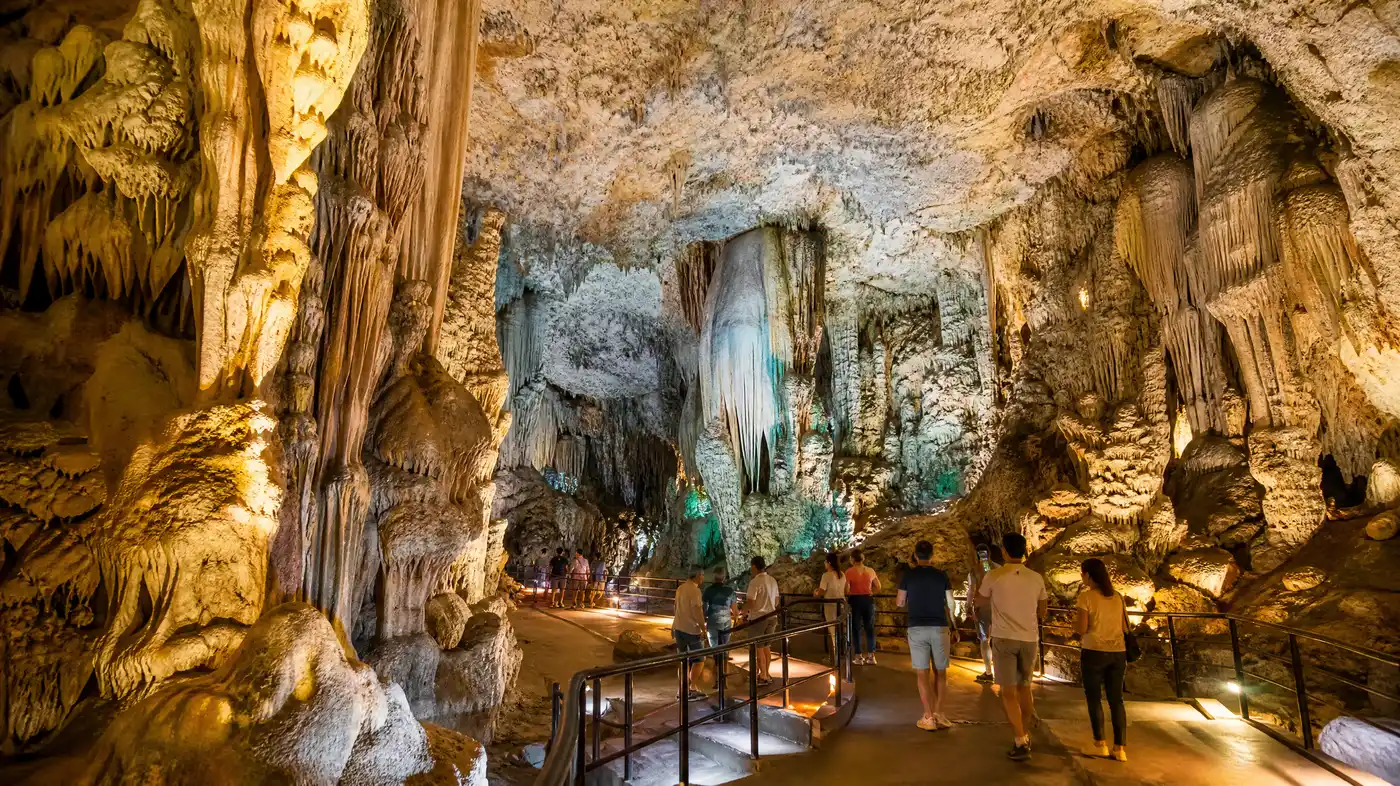
You step through the turnstiles into a moist, cavernous drop, leaving the blinding sun of the Costa del Sol behind for a cool 19 degrees Celsius. Most tourists come for the massive stalactites and the echo of cathedral-sized vaults, yet the real soul of this limestone underworld lies in the pigments smeared across hidden stone walls thousands of years ago. The nerja cave paintings hold a peculiar place in European prehistory, sparking fiery academic arguments about Neanderthal artists, long-extinct Mediterranean monk seals, and ritual sanctuaries tucked away in pitch-black crevices.
There is a catch that catches many first-time visitors off guard. You cannot simply wander past the painted panels on the regular public trail. Conserving fragile prehistoric art inside an active subterranean climate requires strict isolation, which means most travelers must piece together the cave's human story across two separate sites: the underground system in Maro and a modern museum in the heart of Nerja. Understanding how these sites connect changes a simple afternoon excursion into an astonishing journey through 40,000 years of survival.
Book your nerja caves experience:
Discovery and the Nerja Caves History
The entire complex was found by accident on the chilly evening of January 12, 1959. Five teenage boys from the nearby hamlet of Maro - Francisco Navas Montesinos, the brothers Miguel and Manuel Muñoz Zorrilla, José Luis Barbero de Moya, and José Torres Cárdenas - headed out through scrubland to hunt bats at an obscure sinkhole known locally as La Mina. They squeezed down a narrow vertical chimney, kicking away dirt and loose stones, until they dropped into a massive underground space. What they found terrified them. Resting in the dirt were two skeletons beside ceramic vessels.
They panicked and ran home, convinced they had disturbed an ancient curse or stumbled onto murder victims from the Spanish Civil War. Several months passed before a local medical doctor and a photographer crawled down to verify their claims. Word spread through Málaga province like wildfire. Within eighteen months, miners blasted a walkable entrance tunnel, engineers hung electric lights, and the site opened to international tourists in July 1960. That astonishingly fast turnaround would be unthinkable under modern conservation laws, but it opened up one of Andalusia's greatest geological wonders to ordinary travelers.
Subsequent archaeological digs revealed that modern tourists were hardly the first inhabitants to seek shelter under these limestone domes. The nerja caves history covers an astonishing occupational span. Hunter-gatherers first moved into the entry vestibules during the Upper Paleolithic, around 25,000 years ago, leaving discarded flint knives, carved fishhooks, and bone points buried in deep ash layers. Later groups utilized the outer chambers for farming and burial during the Neolithic and Chalcolithic eras. People lived, cooked, ground grain, buried their dead, and eventually abandoned the chambers around 3,000 years ago when the entrance naturally collapsed, sealing the entire cave system like a tomb until five curious boys decided to catch bats.
Note: The original sinkhole where the teenagers squeezed through still exists on the hillside above the visitor center, but it is gated off with heavy iron bars to prevent falls.
The Truth Behind the Nerja Cave Paintings and the Neanderthal Debate
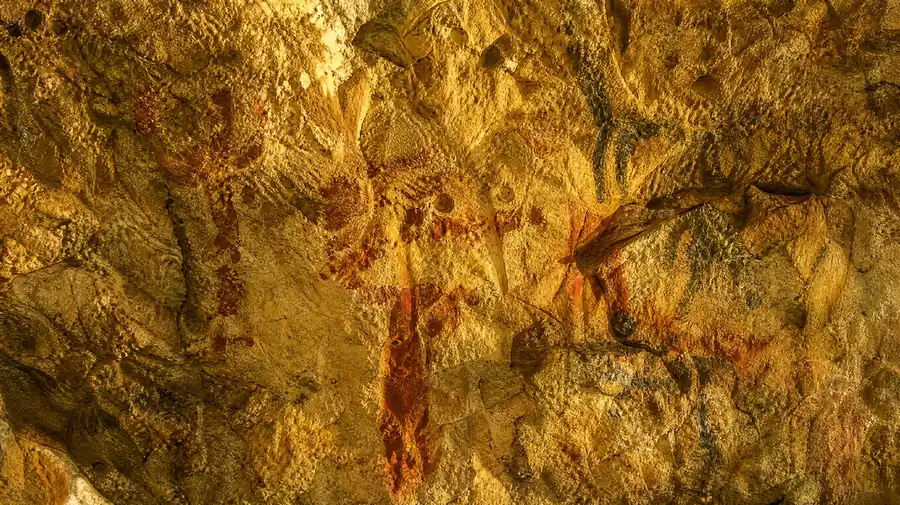
Deep within the restricted galleries, painted images decorate natural folds in the rock. The nerja caves paintings consist of roughly 589 distinct artistic traces. You find schematic red deer, long-horned ibexes, horses, painted dots, ochre strokes, and six charcoal figures depicting marine animals that archaeologists interpret as seals or dolphins. These marine creatures are unusual for cave art in southern Europe, where terrestrial game normally dominates prehistoric murals.
In 2012, researchers led by professor José Luis Sanchidrián sent charcoal samples found adjacent to the seal paintings for radiocarbon testing. The results stunned the scientific community. The dates came back between 43,500 and 42,300 years old. If those dates directly applied to the art itself, the paintings could not have been created by Homo sapiens, who had not yet reached southern Iberia. That meant Neanderthals were the painters. The global press erupted with headlines announcing the world's oldest known art.
Later studies complicated the romantic Neanderthal story. Skeptics pointed out that the dated charcoal samples came from fixed fires on the floor near the walls, not necessarily from the pigment used to draw the seals. Fresh excavations and refined chemical analysis suggest the seal murals are Solutrean or Magdalenian, painted around 18,000 to 14,000 years ago by modern humans who hunted along the ancient coastline. Still, debate continues to rage in academic journals. Walking through the underground rooms, knowing that people gathered by firelight during the depths of the last Ice Age to paint sea mammals on raw rock gives you goosebumps.
Pro tip: The cave's virtual reality experience in the visitor center uses high-resolution digital scans to let you examine the sealed chambers and cave art in 360-degree clarity.
Show Chambers and Where the Nerja Caves Paintings Are Hidden
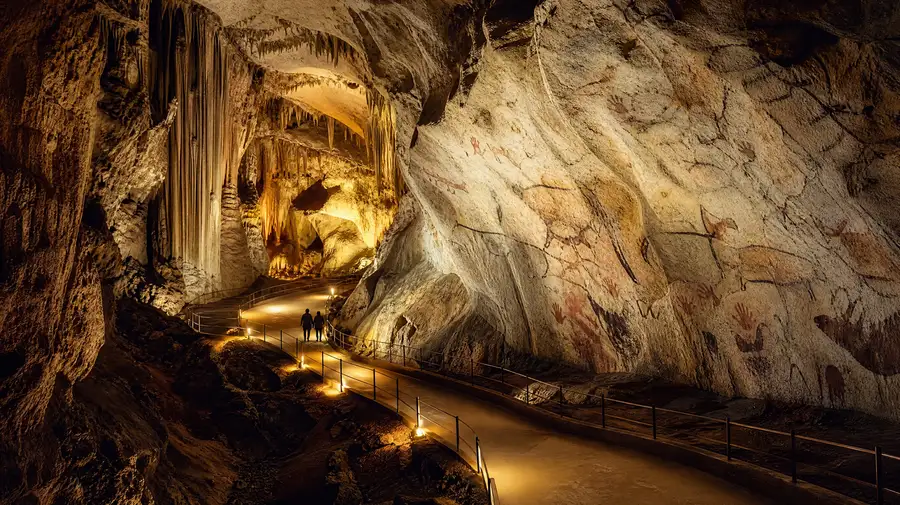
The cave system is split cleanly into three sections. The Lower Gallery, often called the Show Gallery, is what general visitors explore along a 1,061-meter pathway of ramps, bridges, and stairs. The Upper Gallery and the New Gallery contain the delicate nerja cave paintings, prehistoric burial sites, and untouched stalagmite forests. These deep galleries remain completely closed to standard ticket holders to preserve the microscopic climate that keeps the rock art alive.
Before the closures, human breath, rising moisture, and heat from old tungsten bulbs stimulated green algae outbreaks on the porous limestone. Today, climate sensors monitor carbon dioxide levels inside the chambers every ten seconds. The air inside the deep chambers barely moves, maintaining near-total environmental stillness.
| Zone | Length (Meters) | Public Access | Primary Features |
|---|---|---|---|
| Lower Gallery (Show Gallery) | 1,061 | Open daily to public | Cataclysm Room, 32-meter giant column, broad walking trail |
| Upper Gallery | 1,500 | Researchers only | Columns Hall, prehistoric handprints, animal profile murals |
| New Gallery | 2,200 | Strictly restricted | The seal paintings, deep burial pits, delicate speleothems |
If you want a deeper look at the geology without breaking international heritage laws, booking one of the official Nerja Caves guided tours helps contextualize how the open galleries transition into those sealed archaeological zones. Guides will point out the subtle alcoves and shadowed recesses where ancient ash layers were excavated right next to where you walk.
Book your nerja caves experience:
Visiting the Nerja Cave Museum in Plaza de España
Because the real cave paintings remain sealed off underground, you should not skip the nerja cave museum. Located in the center of Nerja inside Plaza de España, right behind the town hall, the museum provides the missing half of the experience. It sits about 4 kilometers west of the actual cavern entrance. Many people visit the cave, grab lunch on the beach, and forget this town museum exists, which is a serious mistake.
The nerja caves museum holds the physical artifacts pulled from the excavation dirt between 1960 and the early 2000s. Glass cases display stone blades, bone needles, shell necklaces, and Neolithic pottery decorated with geometric incised lines. The crown jewel of the collection is "Pepita", the remarkably intact skeleton of an Epipaleolithic woman dating to roughly 8,000 BCE. She was about 18 to 20 years old when she died, standing roughly 150 centimeters tall, and her bones show clear signs of hard physical labor alongside an ear infection that might have caused her death. Looking directly into her skull makes the ancient history of this coast intensely personal.
The museum layout spreads across multiple levels, blending local anthropology with geology:
- Upper floor: Interactive touchscreens, Ice Age wildlife replicas, and scaled archaeological trenches showing how soil layers reveal human occupation.
- Middle floor: The complete skeletal display of Pepita, accompanied by burial goods, flint scrapers, and personal adornments found in the cave vestibule.
- Ground floor: 20th-century cultural history of Nerja, documenting the town's transition from an agricultural fishing village to a tourism hub after the cave discovery.
Entrance to the museum is generally bundled with your main cave entry, making it an easy stop during an afternoon stroll through town. If you need to figure out transportation between the two spots or want to reserve your admission slot, consult our guide on Nerja Caves tickets and discounts before arriving.
Making Sense of the Artifacts: A Timeline
The sequence of human life inside these caverns did not follow a neat, uninterrupted line. People arrived, stayed for generations, retreated during harsh climatic shifts, and returned when coastal conditions improved. Understanding the tools and residues on display in the museum requires grasping three major cultural pulses.
- Aurignacian and Gravettian (circa 30,000 to 22,000 BCE): Small bands of hunter-gatherers took shelter near natural daylight. They gathered wild limpets along the Mediterranean shore, roasted mountain goats, and began marking wall crevices with ground red ochre pigments.
- Solutrean and Magdalenian (circa 21,000 to 10,800 BCE): The peak of artistic activity in the cave. Artists produced the naturalistic animal outlines, including the disputed seal illustrations, using fine charcoal, iron oxide, and animal fat binders applied with fingers and hollow bird-bone blowpipes.
- Neolithic and Bronze Age (circa 4,500 to 2,000 BCE): Hunter-gatherer lifestyle gave way to pastoralism. The cave's outer vestibules served as pens for domestic animals, collective burial chambers, and ceramic production areas before rockfalls blocked the natural entrance.
Archaeologists working in the cave have cataloged over one million animal bone fragments, hundreds of thousands of shell fragments, and tons of worked lithics. It is one of the densest archaeological archives in the western Mediterranean. The fact that early artists crawled through total darkness with small juniper torches, squeezing past narrow rock jaws to paint hidden walls, confirms these caverns were far more than simple shelters. They were sacred, ceremonial terrain.
Frequently Asked Questions about nerja cave paintings
Can tourists see the original nerja cave paintings during a visit?
No. The original paintings are located within the Upper and New Galleries, which are strictly closed to the general public to protect the microclimate and prevent pigment degradation. Visitors can view digital reproductions, high-resolution photographs, and virtual reality displays at the site and in the town museum.
Are the seal paintings really 42,000 years old?
The age remains debated. Radiocarbon tests on charcoal found near the seal murals returned dates between 43,500 and 42,300 years ago, which pointed toward Neanderthal authorship. However, many archaeologists argue that the pigments themselves date to the Upper Paleolithic, around 18,000 to 14,000 years ago, created by modern humans.
Is the Nerja Cave Museum located at the cave site?
No, the museum is located about 4 kilometers away in downtown Nerja, situated in Plaza de España. Your cave admission ticket often includes entry to the museum, so you can explore the cave in Maro and view the recovered skeletons and tools in town later.
How long should I plan for both the cave and the museum?
Plan around 60 to 75 minutes for the cave tour itself, about 45 minutes for the museum in town, and add 20 minutes of travel time between the two locations. A total window of 2.5 to 3 hours covers both comfortably.
Quick Reference
- Paintings located in sealed galleries, not visible on public trail
- 589 cataloged prehistoric graphic units in deep chambers
- Cave discovered by 5 local boys on January 12, 1959
- Museum situated in downtown Nerja at Plaza de España
- Home to Pepita, an 8,000 BCE Epipaleolithic skeleton
Book your nerja caves experience:
Before You Go
The real power of this site hits you only when you pair the natural architecture of the cavern with the tangible relics housed in the town center. Standing beside the massive rock formations inside the cave, you sense the sheer scale of the earth, but standing over the glass case that holds Pepita's delicate skeleton, the human story snaps into sharp focus. Take your time, visit both spots on the same day, and let your imagination reconstruct the flicker of torchlight across ancient stone walls.
Read more about nerja caves.